
Tors tjänare i nordisk mytologi

Imagine a young boy who makes one mistake and ends up spending the rest of his life serving a god. That's exactly what happened to Tjalve in Norse mythology. Along with his sister Röskva, Tjalve became the servant of Thor, the mighty thunder god. But how did a simple farm boy end up in such an extraordinary situation? The story starts with a broken promise, a hungry god, and a choice that changed everything. Let's dive into one of mythology's most interesting tales about duty and consequence.
Den dagen allt förändrades för Tjalve
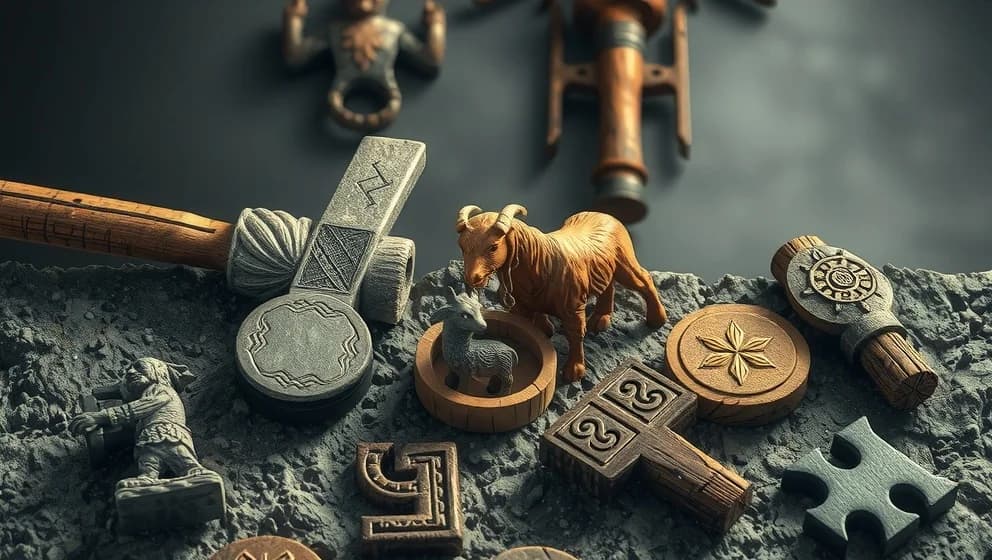
Thor and Loki arrived at a poor farmer's house one evening, exhausted from their travels. Thor had brought along his two magical goats, Tanngnjóstr and Tanngrisnir, which he slaughtered to feed his hungry companions. Before they ate, Thor gave the family one strict rule: don't break any of the bones. Loki, always the troublemaker, whispered to young Tjalve that the marrow inside de bones was the best part. The boy couldn't resist temptation and snapped one of the leg bones in half. The next morning, Thor woke the goats with his magical hammer and prepared to leave. But something was wrong one goat limped badly. Thor's rage was terrifying. He grabbed his hammer and glared at the trembling family with fury burning in his eyes (honestly, you'd probably run). The god demanded payment for the broken bone: Tjalve and his sister Röskva would serve him forever.
Vem var Tor egentligen?
Thor wasn't just any god he was the most powerful protector in the Norse world. Vikings relied on him for protection during storms, battles, and dangerous journeys. His magical hammer, Mjölner, never missed its target and always returned to his hand like a boomerang. The hammer was so heavy that even most giants couldn't lift it. Thor traveled across the nine worlds in a chariot pulled by his two goats, creating thunder with each movement. He was the son of Odin, the all-father, and represented strength, courage and fertility. Farmers wore amulets shaped like his hammer around their necks, hoping for his blessing. To the Vikings, Thor wasn't a distant deity he was their everyday protector, basically.
Tjalve og Röskva på äventyrets väg
Tjalve's name comes from an old Norse word meaning something like "servant elf." The name perfectly described his new role. As Thor's servants, Tjalve and Röskva traveled with the god on his most dangerous missions. Tjalve ran incredibly fast, and his speed made him useful during Thor's adventures. Röskva assisted as well, helping with tasks around camp and during their journeys. Together, they followed Thor to Utgård, the realm of giants, where they witnessed battles and magic beyond imagination. Working for a god wasn't glamorous it was hard, sometimes scary work (not exactly what you'd sign up for). Yet being part of Thor's adventures meant experiencing the myth-making events that shaped the Norse world. The siblings went from ordinary farm children to key players in legendary stories.
Varför bryr vi oss fortfarande om dessa gamla historier?
These ancient myths didn't disappear when Vikings stopped worshipping them. Instead, Thor's stories lived on through books, art, and now movies and video games. Marvel's Thor franchise introduced the thunder god to millions of modern fans. Games like "God of War" feature Thor as a complex character. What makes these stories so lasting? They teach us about real human problems: breaking promises has consequences, loyalty matters, and even small mistakes can change our lives. Tjalve's story reminds us that our choices echo forward. When we break someone's trust or ignore rules, we don't always escape the results. The mythology also shows us that punishment and growth can go hand in hand. Many people today feel drawn to Norse mythology because it deals with themes we still struggle with.
You've now learned how a curious boy became part of legend, and how that ancient story still speaks to us today. The next time you hear about Thor in modern media, you'll know the real story behind his character. Mythology isn't just dead history it's a bridge between ancient wisdom and our modern lives. If you want to dive deeper, search for "Snorri's Edda" online or find books about Thor's journey to Utgård. What would you have done if you were Tjalve? Would you have resisted temptation, or made the same choice?
Vi använder AI för att skapa vårt innehåll. Upptäcker du ett faktafel? Skriv till [email protected].